
Keratoconus
The most common reason for a scleral lens fitting.
Eye care in Tripunithura
Keratoconus is a condition in which the cornea, the clear front window of the eye, thins and bulges into a cone. Glasses cannot correct its uneven surface, so vision stays blurred and distorted. Scleral lenses are one of the most effective ways to restore clear vision, and fitting them is a central part of the work at Nethravaranam.
About keratoconus
A healthy cornea is smooth and evenly curved, and it focuses light precisely. In keratoconus the corneal tissue weakens and thins, and the cornea gradually takes on an irregular cone shape. Light is scattered instead of focused, producing blur, ghosting and distortion.
Keratoconus usually appears in the teens or twenties and can progress for years before stabilising. It often affects both eyes, though one is usually worse. Eye rubbing and allergies are associated with progression.
Symptoms
Keratoconus is diagnosed and monitored with corneal measurements. An ophthalmologist may recommend corneal cross-linking to slow progression. Lenses do not stop the condition. They correct the vision while the cornea is managed.
How scleral lenses work
A scleral lens is a large rigid gas permeable lens. Instead of resting on the cornea, it vaults completely over it and lands on the sclera, the white of the eye.
Before insertion the lens is filled with sterile saline. That fluid fills the space between the lens and the irregular cornea, so light enters the eye through the smooth front surface of the lens. The fluid also keeps the cornea constantly hydrated, which is why scleral lenses are used for severe dry eye too.

Who they help
The most common reason for a scleral lens fitting.
For irregular vision after a graft, once the surgeon agrees the eye is ready.
For irregular vision or complications after LASIK.
The lens masks the uneven surface left by a scar.
The saline reservoir keeps the corneal surface moist all day.
For people who cannot tolerate smaller rigid lenses.
Benefits
Fitting at Nethravaranam
Your corneal shape, current vision and history are reviewed, including any cross-linking or surgery.
Scleral lenses from the fitting set are placed on the eye and assessed for clearance over the cornea and landing on the sclera.
The lens is designed to the measurements from your fitting and ordered.
You learn the filling, insertion and removal technique at the clinic, with practice until you are confident.
Regular reviews check the fit and the health of the cornea as you wear the lenses.
Patient stories
Two patients talk about their vision before and after their lenses.
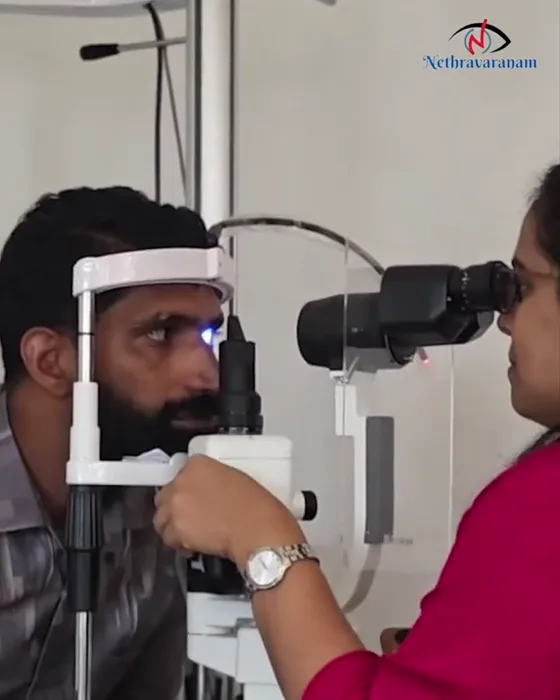 Patient story · KeratoconusStable cornea, blurred sightC3R stopped Lijo’s keratoconus from getting worse, but it could not clear his sight. He lived with the blur for 16 years, until the clinic fitted him with scleral lenses.
 Patient story · Scleral lenses“I can do better”Basil, from Kollam, on the years before scleral lenses and the five years he has worn them since. In Malayalam.
In their words
“Living with keratoconus felt like seeing the world through a frosted window. Over the years, my vision steadily worsened, and simple tasks (reading, working, even recognising faces) became increasingly difficult. Standard glasses offered no relief. From the very first fitting, everything changed. For the first time in years, my vision became crisp and clear again.”
“I had been struggling with my eyesight for a long time. Following an eye specialist’s advice, I have been using scleral lenses for the past three years. Since I started using them, my vision began to improve, and now I can see everything clearly.”
“Give me big support when I purchase mini scleral lense. Doctor is very supportive and makes me very comfortable before purchase. After sales also giving proper guidance in every problem arises.”
FAQ
No. They correct vision while you wear them. Whether the condition is changing is monitored separately, and an ophthalmologist decides on treatment such as cross-linking.
They should not. The lens rests on the white of the eye, which is far less sensitive than the cornea. A lens that causes discomfort needs its fit checked.
There is a technique to filling and inserting the lens, and most people find it awkward at first. You practise at the clinic until you can do it yourself.
Many wearers manage a full working day. Your optometrist sets a wearing schedule and increases it over the first weeks.
Often, yes, once your surgeon agrees the eye is ready. Bring your surgical reports to the assessment.
With proper care, scleral lenses typically last a year or more. Your optometrist will advise when to replace them.
A scleral lens can be fitted to the affected eye alone, with glasses or another lens for the other eye.
Find us
Ground Floor, BK Building, SN Junction, near the metro station
Tripunithura, Kochi, Ernakulam, Kerala 682301
Call or WhatsApp +91 80787 42248, or call +91 90747 90747
For a speciality lens fitting, message ahead so the optometrist can set aside enough time.